Travelling Shows and the Idea of a Festival Day
Travelling shows and festival days are different ways to gather around performance. See how a shared programme can turn separate acts into a day out.
The common mistake in thinking about travelling shows and festival days is to treat one as the direct historical ancestor of the other. Without a documented account, that tidy story costs us the more useful distinction: a travelling show centres on a performance brought to a place, while a festival day asks an audience to make a shared occasion from several offerings. The imagined scenes here are illustrations, not claims about how festivals developed in any particular town.
A show comes to town
Say an invented market town receives a notice that a travelling company will perform in a hall. The notice names the players and the subject; on the day, a handbell draws people towards the entrance. The company brings the performance, the audience gathers, and the occasion has a clear centre: the show itself.
Some visitors might arrive early or linger afterwards, but those moments still orbit the performance. The audience’s main choice is whether to attend. A mobile company can organise its own visit, while the host provides a suitable space and permission; neither arrangement needs to imply a broader festival.
That is a useful conceptual contrast, not a history of a particular tradition. Travelling performers can also appear within festivals, and a single performance can be part of a much larger civic or seasonal gathering.
Several acts, one occasion
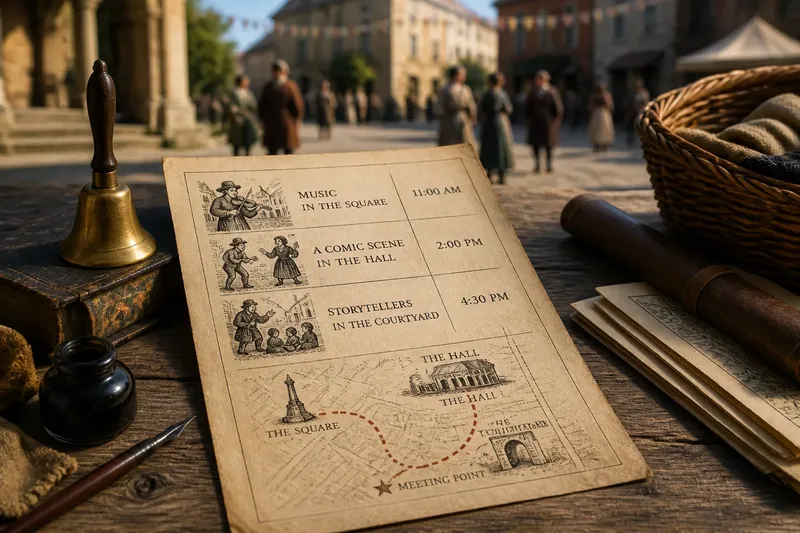
Now imagine the same invented town hosting a musician in a square, a comic scene in a hall and storytellers in a courtyard. These acts remain distinct. They begin to feel like parts of one event only if something connects them for the public: a shared invitation, a common setting, a theme or an organiser’s programme.
This larger invitation changes the audience’s choice. Instead of deciding only whether to attend one show, visitors can decide where to go, what to stay for and whether to leave time between performances. The town becomes more than a backdrop: its streets and meeting places help shape the day.
For a festival-goer, the practical question is not whether a schedule exists, but whether it makes the relationship between events clear.
What connects a festival day?
A programme can list times and places, but a list alone does not create a shared occasion. Visitors need some legible connection between the events: perhaps a common meeting point, a host organisation, a theme or a route that makes separate venues feel part of one gathering.
In the invented town, an organiser might post a single notice with the acts, locations and a simple map. The notice gives people practical choices and frames the events as a group. It need not dictate a fixed route; one visitor can see the opening music and leave, while another can move between performances.
Imagine the organiser’s starting point is three events in separate spaces, with no shared information. They put the times and addresses on one notice, mark the hall and courtyard on a hand-drawn map, and name the square as a meeting point. The resulting answer is straightforward: visitors can see which acts belong to the same occasion and choose a route, though the organiser still has to consider whether the spaces are easy to find and use.
Planning a legible programme
For anyone shaping a small gathering, these checks help turn a collection of bookings into an understandable invitation. Each observation should lead to a decision, with an alternative if the answer is no.
- Check whether every event has a named location; if it does, list it beside the event, and if it does not, confirm the venue before publishing.
- Check whether the start times leave visitors a plausible chance to move between spaces; if they do, show the sequence, and if they do not, move an event or make the overlap explicit.
- Check whether a visitor can identify the shared occasion from the notice; if the connection is clear, keep the framing, and if it is not, add a common theme, host or meeting point.
- Check whether the route between venues is explained; if directions are clear, include them, and if not, add a map or point visitors towards a central information spot.
- Check whether visitors can attend just one event without feeling they have missed essential instructions; if they can, state that plainly, and if they cannot, explain the shared opening or closing that matters.
- Check whether the programme names any access or entry arrangements visitors need; if the information is confirmed, publish it, and if it is not, ask the venue or organiser before making claims.
A useful programme leaves room for different kinds of attendance. It makes the available choices visible without insisting that everyone follow the same route.
Who shapes the gathering?
In the invented town, performers supply the acts, organisers connect them, host spaces make room, and visitors give the schedule its lived pattern. No single role accounts for the whole occasion. The programme also expresses choices: putting particular forms together suggests what the gathering wants to invite people to notice.
Practical details affect whether that invitation is easy to accept. Clear directions, a recognisable information point and welcoming spaces help people understand where to go. If the events use several locations, a map or signs can make the structure visible without turning the day into a compulsory route.
A visitor who attends only one performance can still be part of a festival day, just as someone who follows several acts can. The shared frame matters more than completing every item on a schedule.
How do shows and festivals differ?
What separates a travelling show from a festival day?
A travelling show centres on a performance brought to a place. A festival day connects multiple offerings as one public occasion, though it may include travelling performers.
Does a programme make a festival?
A programme helps people see what is happening and how events relate. A printed list without a shared invitation or intelligible connection may still feel like unrelated bookings.
Why does location matter?
Shared spaces can help visitors recognise the events as part of one gathering. When venues are separate, directions, a map or a meeting point can make the links easier to follow.
Can a festival day stay informal?
Yes. Organisers can explain the available events while leaving visitors free to attend one, several or none. A clear programme need not prescribe a single way to spend the day.
Reading a festival programme
Return to the invented market town: first, its notice announces one travelling performance in a hall. Later, an organiser invites a musician, a comic act and storytellers to different spaces, then lists their locations together and marks a common meeting point. The observable result in this imagined situation is that visitors can recognise a shared occasion and choose which events to attend; it does not establish a real historical transition.
That distinction is useful when you pick up a festival programme. Look beyond names and times for the threads that bind its events: a shared subject, a welcoming central space or a route between venues. Those details tell you what kind of day the organisers are proposing and help you decide how to join it.
When comparing festival days, check whether the programme gives you enough information to make your own route. A clear address, a visible connection between events and an honest account of what is optional can make the difference between a schedule you can use and a list that leaves you guessing.