One Long Festival Event or Several Short Ones?
One long festival event or several short ones? Match the format to your attention and curiosity, so you can choose performances that feel rewarding.
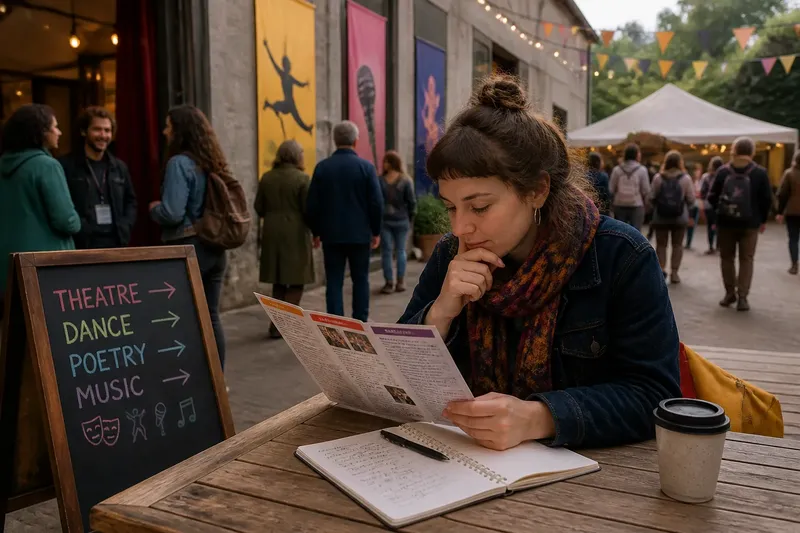
The common mistake when choosing one long festival event or several short ones is to assume the longer programme offers more value. That can cost you the pleasure of following a performance closely—or of discovering different voices and styles. The better choice depends on the kind of experience you want from the work itself.
Choose your attention
A long event can reward patient observation. In a full theatre piece, concert set or film, a detail introduced early may return with a different meaning; you have time to notice how the work changes. If you enjoy following a single artistic thread, that gradual build can be the main attraction.
Several short events offer a different pleasure: comparison. A spoken-word performance followed by a dance piece, for instance, can make you notice how each uses silence, movement or language. The contrast becomes part of the experience, rather than a distraction from it.
Think about what you most enjoy discussing afterwards. Is it the way one performance developed, or the surprising differences between several? That answer is a better guide than the number of items on the programme.
Read the programme
Running time alone does not tell you what a performance asks of its audience. A long event may be made of distinct sections, while a short one may rely on close listening or an unusual format. Read the description for clues about the structure, style and intended audience experience.
Check practical details that could affect your choice: whether the work is complete or excerpted, whether late entry is permitted, and whether it is seated, standing or participatory. For access requirements, content notes and entry conditions, use the organiser’s current information.
A programme note that mentions improvisation, audience interaction or a continuous narrative can help you picture the encounter. If the description leaves you unsure, contact the organiser rather than guessing.
What suits your pace?
What does a long event offer?
A longer work can give an artist room to develop an idea and let you see its parts in relation to one another. It may suit you if you like sustained concentration or prefer to settle into one performance rather than compare several.
What do short events offer?
Short performances can bring you into contact with different forms, artists or subjects. They may appeal if you enjoy noticing contrasts and moving between distinct creative approaches.
Can the formats be combined?
Yes. You might pair one substantial performance with a brief event that offers a different art form or mood. The point is to make the contrast meaningful, rather than to treat each slot as a separate achievement.
What if your preference is unclear?
Choose the description that makes you curious about the work, not simply the one that seems easiest to fit into a programme. If you remain undecided, consider whether you would rather leave with a detailed impression of one piece or a set of comparisons.
Compare the formats
Use these checks to connect the programme to the experience you want. For each observation, follow the decision that fits; if the first option does not suit you, the alternative keeps the choice open.
- Check whether the long event has a continuous story or argument. If you want to follow one unfolding idea, choose it; if you prefer separate encounters, look for self-contained short events instead.
- Check whether the short events share a theme or artistic approach. If you enjoy comparing related work, choose a cluster; if you want a more complete arc, favour one longer piece.
- Check the format listed for each performance, such as seated, standing, roaming or participatory. If that format suits how you like to watch, keep it in contention; if not, choose an event with a more comfortable mode.
- Check whether the event description mentions audience interaction. If you welcome taking part, consider it; if you would rather observe, choose a performance described as non-participatory or ask the organiser.
- Check whether late entry is allowed. If arriving at the start is realistic for you, the event remains an option; if not, choose one whose entry policy fits your circumstances.
- Check the content and access information against your needs. If it answers your questions, use it to decide; if anything remains unclear, ask the organiser before booking or choose an event with information that is clear to you.
Test a pairing
Imagine you are choosing between a long theatre piece and three short performances: a poetry reading, a dance work and a music set. You enjoy noticing how artists shape silence, but you find switching between crowded rooms tiring. The reading and dance work both use quiet pauses, while the music set is described as loud and participatory. You decide that the long theatre piece is the stronger fit because it gives you one sustained work to follow; if you later want a contrast, you can choose just the reading rather than trying to attend all three.
The decision changes if your interest is comparison rather than continuity. You might choose the reading and dance work to see how two artists use silence in different ways, while leaving the music set aside because its participatory style does not appeal. The result is not a fuller or thinner programme, but a choice shaped by what you want to notice.
Try asking what you hope to observe: a work’s development, the differences between artistic approaches, or the effect of a particular setting. That question makes a programme feel less like a menu to clear and more like a set of possible encounters.
Let the work lead
One long festival event or several short ones can both make a rewarding visit. A long performance offers the chance to stay with one evolving idea; shorter events can put distinct forms and perspectives beside one another. Neither is automatically the more serious or adventurous choice.
Let the programme’s form, subject and way of involving its audience guide you. If a description sparks a specific question—how a story resolves, how a dancer uses space, or how two performers interpret the same theme—that curiosity is a useful reason to choose it. The best fit is the event, or combination of events, that gives you something particular to notice.